How to adjust a Shimano rear derailleur
Step-by-step guide to adjusting a Shimano rear derailleur: H and L screws, cable tension, alignment with the cogs and a gear test, with mistakes to avoid.
By the Velunite editorial team
~45 min · Difficulty: medium · Brands: Shimano · Published on 22 November 2026

A gear change that skips, rattles or will not reach the largest sprocket can usually be fixed with two screws and some patience. Adjust with the bike on a stand and the rear wheel fitted. The method covers most Shimano rear derailleurs with 9, 10, 11 and 12 speeds, on road, gravel and mountain bikes. For the exact values of your model, check the manufacturer's manual.
Tools you need
- Small Phillips screwdriver or Allen key, depending on the derailleur
- Chain lubricant
- Rag and degreaser
- Cable pulling tool, if you need to tension the cable
Step by step
Clean and check the derailleur
Before adjusting, clean the chain, cogs and derailleur pulleys. A dirty derailleur does not respond well to the screws, even when the adjustment is correct. Check that the derailleur hanger is not bent: a crooked hanger moves the derailleur out of line and no screw can correct it.
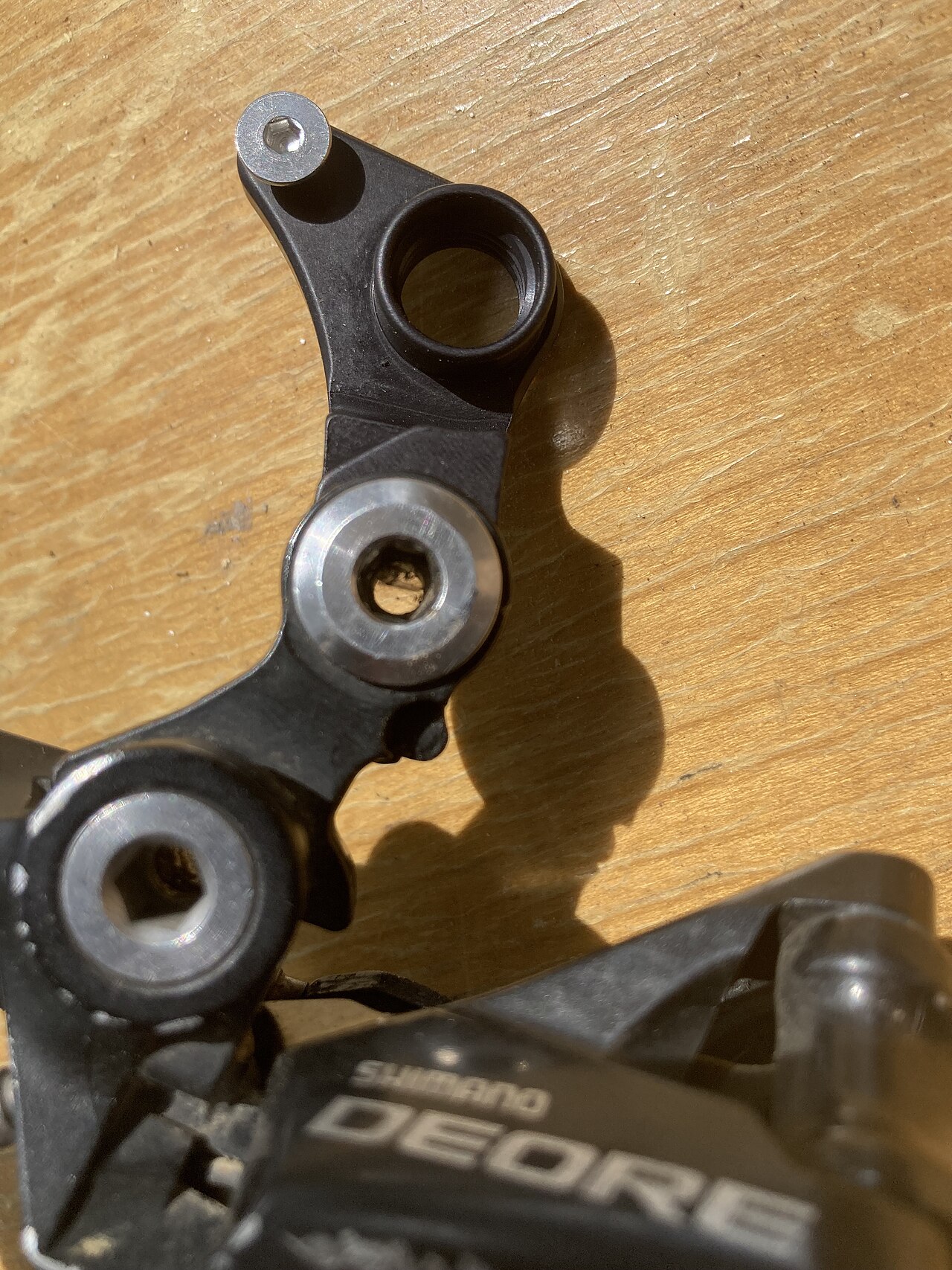
Derailleur hanger mounted on the frame: if it is bent, no screw can correct it. Photo: Jberkel, CC0, Wikimedia Commons Move the chain to the smallest sprocket
Shift the chain onto the smallest sprocket, the one closest to the frame, using the shifter. Look from behind: the guide pulley must line up with the sprocket, on the same vertical line.
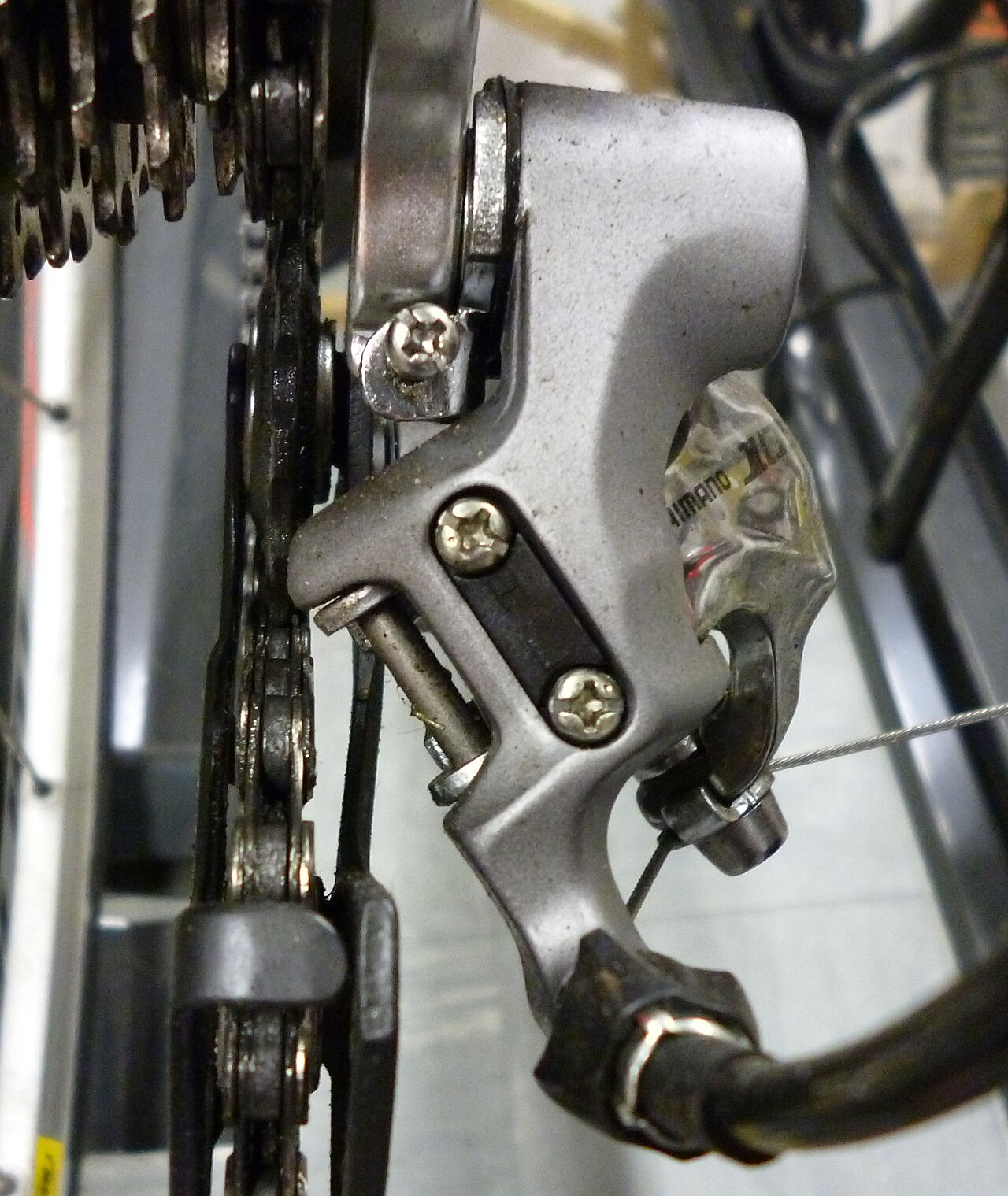
Shimano rear derailleur with its adjustment screws. Photo: Armchair, CC BY-SA 3.0, Wikimedia Commons Adjust the H screw (high limit)
With the chain on the smallest sprocket, turn the H screw, usually marked with an H, until the pulley lines up with the sprocket. If the chain tends to climb past the smallest sprocket into the spokes, tighten the H screw. If it stays short of the sprocket or will not climb, loosen it. Work in small steps of a quarter turn.
Set the cable on a middle sprocket
Move the chain to a middle sprocket, for example the fourth or fifth. Turn the cable barrel adjuster, or the adjuster on the derailleur, until the gears shift up and down smoothly. If the barrel is at its limit, loosen the cable clamp bolt, pull the cable tight with the tool and tighten again, then try the barrel adjuster once more.
Adjust the L screw (low limit)
Move the chain to the largest sprocket. Turn the L screw, marked with an L, until the pulley lines up with the largest sprocket. If the chain will not climb onto the largest sprocket or falls off beyond it, adjust the L screw. Do not force the lever while adjusting.
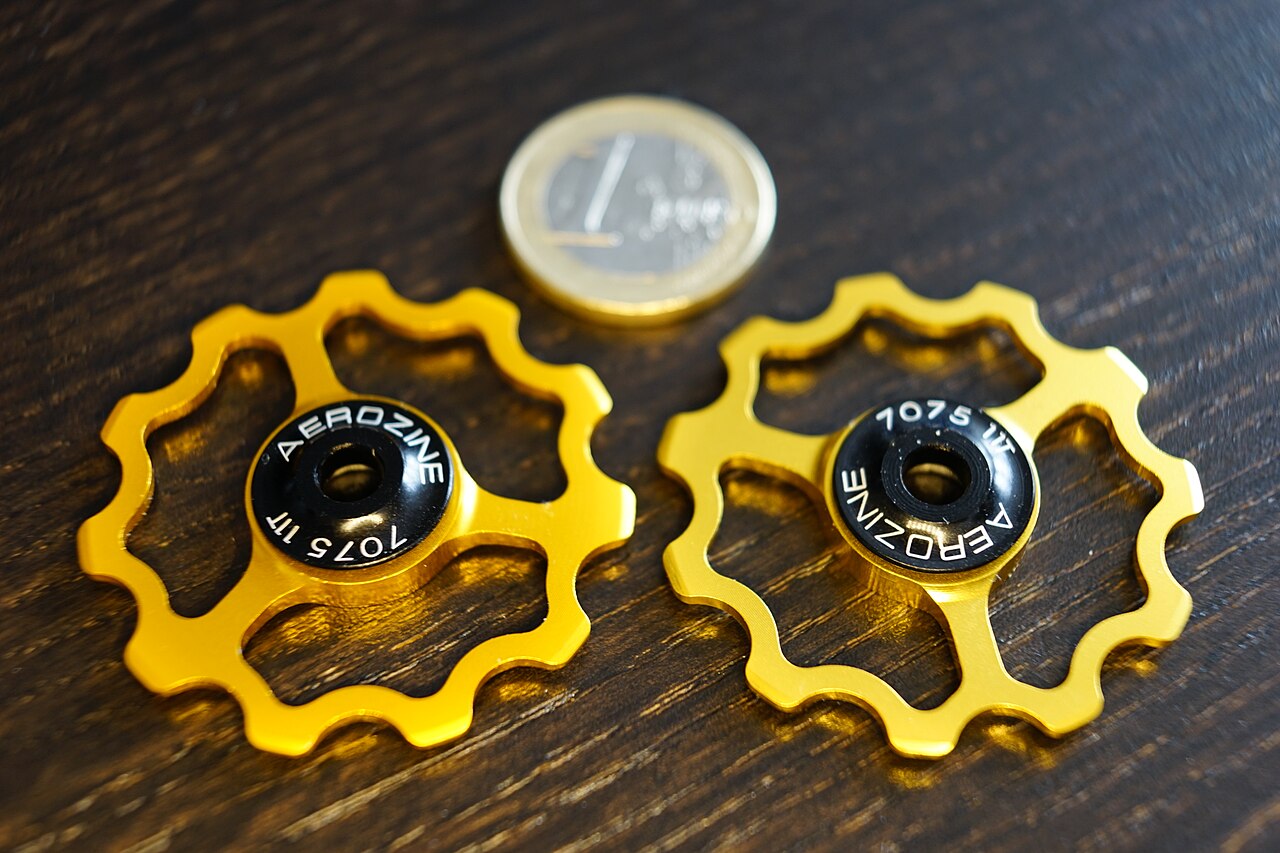
Guide and tension pulleys of a rear derailleur. Photo: Sam Sailor, CC BY-SA 4.0, Wikimedia Commons Check the pulley gap
With the chain on the largest sprocket, the guide pulley must sit close to the sprocket without touching it. On the smallest sprocket it must stay aligned but far enough away. If needed, use the B screw to move the pulley closer or farther. If the chain rubs on the smallest sprocket, adjust the B screw and test again.
Test the gears while moving
Turn the pedals by hand and go through all the gears, up and down. The derailleur must shift without hesitation, without noise and without the chain skipping. Take a test ride on flat road and check the shifts under load. If one gear is not precise, go back to the H or L screw for that gear.


Mistakes to avoid
- Turning the screws too far in one go: the adjustment becomes hard to find and the derailleur stays out of place.
- Confusing the H screw with the L screw: the first controls the smallest sprocket, the second the largest.
- Tightening the cable without first loosening the clamp bolt: the cable can fray or the derailleur will not return.
- Adjusting the derailleur with a bent hanger or a crooked frame mount: the problem stays even with the right screws.
Frequently asked questions
Why does the chain always skip on the same sprocket?
Usually the cable has stretched or the barrel adjuster is no longer enough. Adjust the barrel first. If that is not enough, check that the cable is correctly tensioned and that the chain is not worn: a worn chain skips even when the derailleur is adjusted.
Do I need to adjust the derailleur after changing the chain?
Not always, but often yes. A new chain of a different length can change the tension. After replacing the chain, always test all the gears.
How long does it take to adjust the derailleur?
For a first attempt, about an hour if you go slowly. With experience, a routine adjustment takes a few minutes.
Track chain wear, pads and tyres for every bike in Velunite: see when chain and pads need checking.
Open My bikes