Wheels: truing and spoke tension, a practical guide
How to tell whether a wheel is out of true, how to check spoke tension and how to true it with a spoke wrench without making it worse.
By the Velunite editorial team
~60 min · Difficulty: medium · Brands: Tutte le marche · Published on 23 November 2026

An out-of-true wheel rubs the brake, wears the pads and, in extreme cases, loses spokes or lets the rim fail. Often you do not need a mechanic: you need to understand where the problem is and act with little force and in small steps. This guide explains how to find the lateral and radial run-out, how to read spoke tension by plucking, how to true the wheel and when to stop and take it to a mechanic. Work with the wheel fitted on the frame or in a stand, with brakes adjusted and the tyre inflated to the correct pressure.
Tools you need
- Spoke wrench of the right size, with no sharp edges
- Wheel stand, or the bike turned upside down on a frame stand
- Fixed reference: a zip tie or a marker pointer
- Your fingers, or a spoke tensioner, to read spoke tension
- Grease or oil for spoke threads, only if the manufacturer specifies it
Step by step
Find the point that is out of true
Mount the wheel in a stand, or turn the bike upside down on a soft surface. Bring a fixed reference, such as a zip tie or the tip of a locked screwdriver, close to the rim, a few millimetres away. Turn the wheel slowly: the point where the rim gets closer to the reference is the area that wobbles sideways (lateral run-out). Repeat for radial run-out, meaning the rim rising or dropping relative to the hub: then place the reference above or below the rim. Mark the points and the size of the run-out with a pen, so you work from data and not by eye.
Check spoke tension
Before touching the wheel, check that the spokes have similar tension. Pluck each spoke between index finger and thumb, like a string, and listen: they should sound similar. A loose spoke sounds dull and gives; a spoke that is too tight sounds high. Compare one side of the wheel with the other: if all spokes on one side are loose and those on the other are tight, the wheel is unbalanced and you cannot true it by adjusting one area alone. This test tells you what job is ahead.
Tighten or loosen in small steps
The rule is simple: to move the rim towards one side, tighten the spoke that pulls from the side where the rim must go by a quarter turn, or loosen the spoke on the opposite side by a quarter turn. Work one spoke at a time, half a turn or a quarter at most, and read the run-out again. Tightening one spoke too much pulls the rim and can take tension away from the others. For every spoke you tighten, loosen the one across from it a little, to keep overall tension balanced.
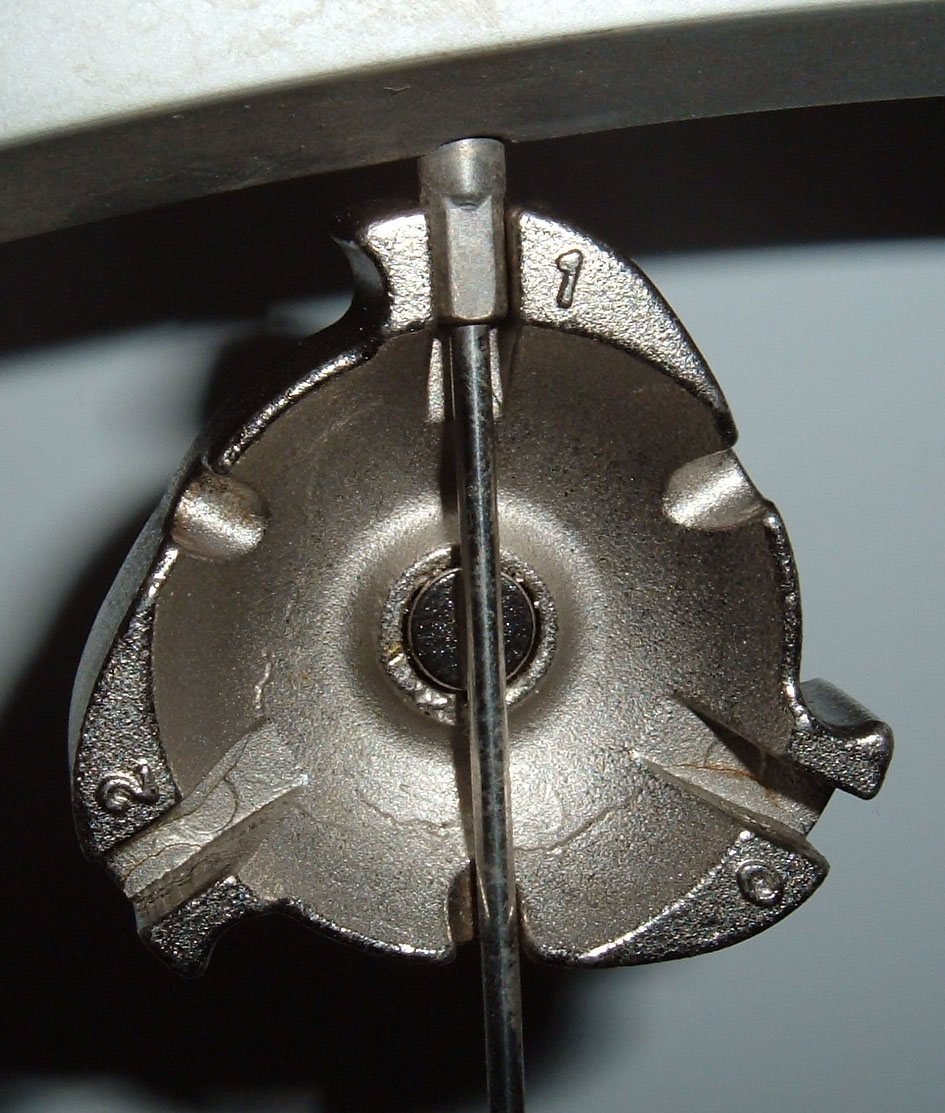
Spoke wrench in use on the wheel. Photo: Scott Ehardt, Pubblico dominio, Wikimedia Commons Repeat until the wheel runs true
Turn the wheel, read the run-out again with the reference, and work on the area that still wobbles. You usually need more than one cycle, because each correction moves the rest a little too. Do not try to perfect everything at once: first get the run-out under about two millimetres, then refine. A true wheel does not mean all spokes are identical in tension, but that the rim runs straight and tension is balanced. If the wheel jumps repeatedly, check for a broken spoke or a dented rim: in that case truing alone is not enough.
Check the brakes, the hub and the bearings
With the wheel nearly true, check the brakes: on a rim brake the rim must not touch the pad at any point, on a disc brake the rotor must not touch the pads. Check that the hub is tight and that the bearings have no play: a slack or loose hub makes a wheel look out of true even when it is not. Tighten or adjust according to the hub type and the manufacturer's instructions.
Recheck after a few rides
New or freshly tensioned spokes settle. After the first rides, or after some turns on the stand, the tension can change and the wheel may wobble a little. Check the truing and tension again after the first few kilometres, and then from time to time, especially with temperature changes. If the wheel keeps losing true quickly, there is a problem: broken spokes, a damaged rim or a hub with play.
Know when to stop
There are situations where home truing is not enough. A dented or bent rim, a damaged carbon rim, spokes that break often, or a wheel that must be rebuilt with new spokes need a mechanic or a wheelbuilder. If the wheel must be re-spoked, a professional does it. Do not force it: too much force on the rim or a spoke pulled too tight will ruin it.
Check the pressure and the tyre
A flat tyre, or one inflated unevenly, can make a wheel look out of true. Inflate to the pressure marked on the tyre, check the tyre sits centred in the rim all the way round and that there are no unusual wear patterns. A wheel that seems out of true because the tyre is misplaced is fixed with very little.
Mistakes to avoid
- Tightening one spoke without loosening the one opposite: overall tension rises and the rim deforms.
- Truing by eye without a reference: run-out of a millimetre cannot be seen but still rubs and wears.
- Forcing a broken spoke or a bent rim: the damage spreads and the wheel becomes unsafe.
- Ignoring hub play: it makes the wheel look out of true, and the truing will not hold.
- Working with an unadjusted rim brake: the rim rubs and wears, and the truing gets blamed.
Frequently asked questions
How far out of true does a wheel have to be before it needs truing?
As a practical reference, lateral run-out of more than two millimetres is visible by eye and often rubs the brake. On a racing wheel the tolerance is tighter. The rim manufacturer may give a precise value.
Do I need a torque key for spokes?
For home truing a tension-adjusted spoke wrench is useful but not essential: what matters is working in small steps and comparing spoke tension by plucking. For a working or competition wheel, a wheelbuilder with measuring tools is the better choice.
Can I true a wheel without taking it off the frame?
In many cases, yes. With the bike upside down and a fixed reference you can work on the rim. A wheel stand makes it more precise, but it is not essential for basic truing.
How much does a mechanic charge for truing?
It varies a lot by area and wheel type. Roughly, it is a half-hour job or a little more; ask the price first and get hub play and spoke tension checked too.
Why does the wheel lose true so quickly?
The most common causes are spokes with uneven tension, a loose spoke, a hub with play or a damaged rim. If the wheel goes out of true right away, check these four points before truing it again.
Track chain wear, pads and tyres for every bike in Velunite: see when chain and pads need checking.
Open My bikes