Chicago, 2:01:09: the second half cost just 27 seconds
Kipruto won Chicago in 2:01:09 with a second half almost identical to the first. What we can copy, scaled down, for your own marathon pacing.
Free, in 1 minute: save routes, download the GPX and join group rides.
Sign up freeWritten by the editorial team at Velunite
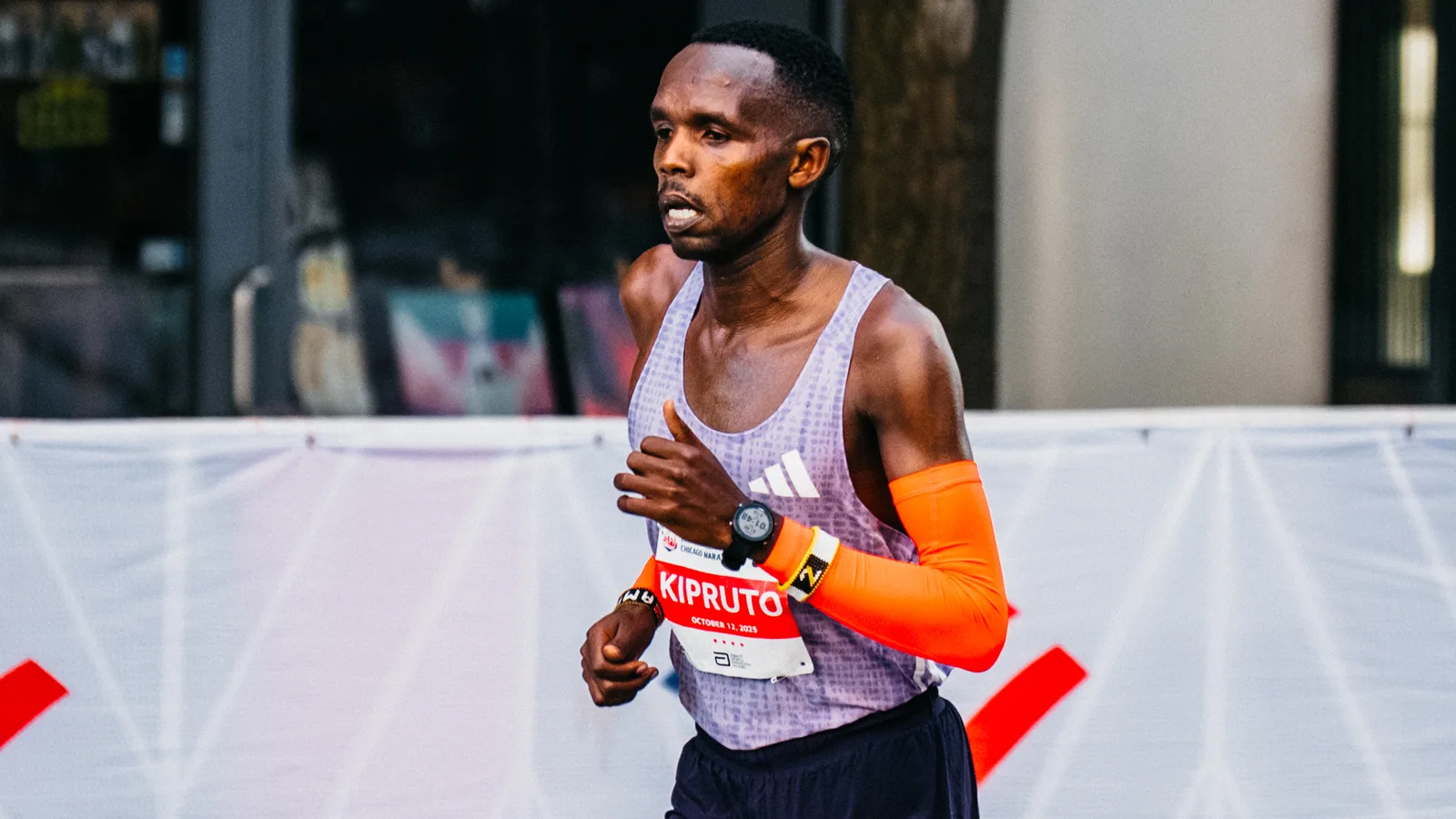
On Sunday 11 October Amos Kipruto won the Chicago Marathon in 2:01:09, a personal best. Two sources, Marathons.com and the Find Your Edge report, give the same halfway split: 1:00:21. Let's do the sum, because it is the most interesting number in the story: 2:01:09 minus 1:00:21 is 1:00:48. The second half was slower than the first by 27 seconds, over more than an hour of running. For a normal runner it is an invisible difference; for a marathoner it is close to perfection.
The race in brief
Kipruto, from Kenya, finished ahead of the Ethiopians Tadese Takele Bikila (2:02:56) and Milkesa Mengesha (2:03:46). Jacob Kiplimo, the defending champion, was fourth in 2:04:18 after fading late, while Kelvin Kiptum's course record of 2:00:35 stays where it is. The women's race was close too: Hawi Feysa defended her title in 2:13:33, ahead of Sharon Lokedi (2:14:07) and Brigid Kosgei (2:14:55). According to both sources the decisive moment came just before 35 km, when Kipruto changed pace. On the weather the sources disagree (one speaks of a cool, windless day, the other of heat and humidity), so we do not state it as fact.
Why 27 seconds say so much
Here is what made us write this piece. The amateur marathoner usually does the opposite: starts hard because it feels good, reaches 30 km with wooden legs and loses three, five, ten minutes in the second half. It is the most common mistake and almost all of us have made it at least once. A half in 1:00:21 and a second one in 1:00:48 tell of a race in which the first part was kept under control even by people running at paces we will never see.
We are not saying we should all run a second half half a minute slower: it depends on the course, the day, the legs. But a prudent rule, found in nearly all the pacing literature, is that the first half should feel easy, almost too easy. If at halfway you feel like a champion, you have usually run too hard.
How to bring it into your marathon
Try thinking in three blocks. In the first ten kilometres force yourself to stay a few seconds per kilometre slower than the pace you would like to hold. From ten to thirty-five keep the rhythm, without chasing faster groups. After 35, and only then, look at what you have in the tank: if there is something, push, as Kipruto did. Our marathon time calculator gives you a realistic starting pace from a recent race, and if you run Venice on Sunday 25 October you will find course and tips in our Venicemarathon guide. For the last weeks there is also tapering.
A concrete example, with our own numbers and not Kipruto's: if you are aiming at 3:30:00, a half in 1:45:00 is the perfect even split. Going through in 1:43:30 feels like a gift, but it only lends you time that kilometre 30 will take back with interest. The reasoning holds on shorter distances too, half marathons included. It is not a law, it is a rule of thumb: if you have doubts about your load or your condition, talk to a coach or to your doctor.
An honest caveat: the data come from race reports that were not yet official at the time of writing, and the intermediate splits are those of the two articles cited. We did not compare the results with the race's official website.
Our opinion
We would like it if, after Chicago, we stopped seeing records as something far away and started looking at how they are run. Kipruto's time is off the scale; the rhythm he built it with is not. A well-paced race always feels a little scary, because it asks you to give up the euphoria of the first stretch. Then, after 35, it gives everything back.
Where do you stand: do you start cautiously, or go out hard and see what happens? What is your worst second half? Tell us in the comments, and if you have a marathon coming up, tell us what pace you will run it at.
Comments (0)
No comments yet. Be the first!
Attrezzatura consigliata
Affiliate links: if you buy through these links Velunite receives a small commission, at no extra cost to you.
More articles
Latest from the Journal
- Hinault and LeMond, 1986: betrayal or a team lesson?October 21, 2026
- Amsterdam, 2:03:33 in the rain, and a faster second halfOctober 21, 2026
- New York 2026: 50 years of five boroughs and three ItaliansOctober 20, 2026
- Sallanches 2027: the Domancy, twenty times, and Pogačar's planOctober 20, 2026