Amsterdam, 2:03:33 in the rain, and a faster second half
On Sunday in Amsterdam eight men ran under 2:05 and the women's course record fell, in the cold. The real number is the second half: the maths and what you can learn.
Free, in 1 minute: save routes, download the GPX and join group rides.
Sign up freeWritten by the editorial team at Velunite
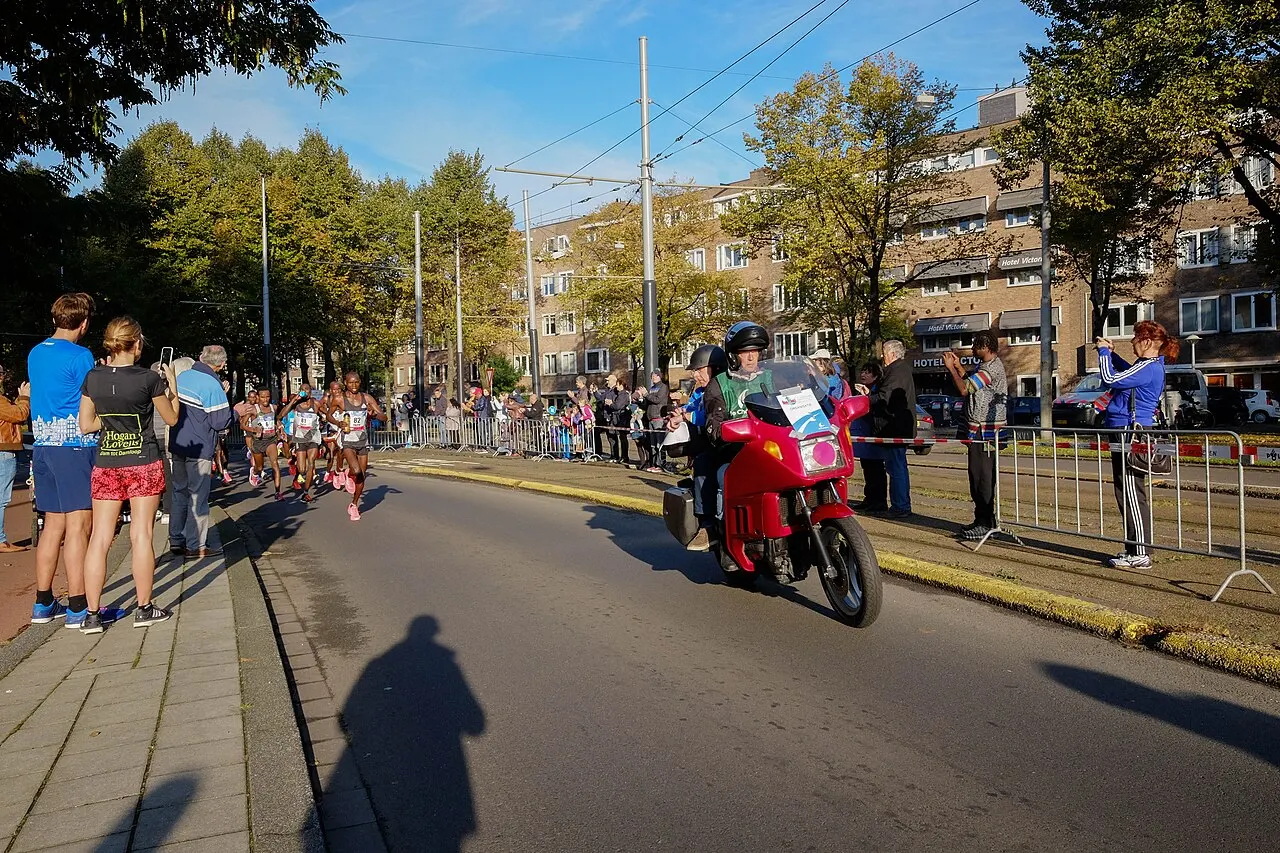
On Sunday 18 October, on wet roads and in the cold, eight men ran under 2:05 in Amsterdam and one woman took 40 seconds off the course record. But the number that made us stop is a different one: the winner of the men's race ran the second half marathon faster than the first. In the rain. We did some sums, and we think they say something even to people who run in four hours.
What happened
The TCS Amsterdam Marathon was won by Lemi Berhanu of Ethiopia in 2:03:33, three seconds off the course record that Geofry Kipchumba set in 2025 (2:03:30). Berhanu, the 2016 Boston champion, improved his personal best by about a minute, and that mark had stood for ten years. Second was Kenya's Nicholas Kipkorir in 2:03:39, in only his second marathon (his debut, in Boston in April, was 2:06:07), and third Patrick Mosin in 2:03:58.
The first eight went under 2:05, and World Athletics notes that this has happened only three times in marathon history. In the top ten everyone was under 2:06 (Watch Athletics counts eleven under that mark; we verified the first ten).
In the women's race Buze Diriba of Ethiopia won in 2:16:12 (some Dutch sources report 2:16:10; we follow World Athletics), a course record: the previous 2:16:52 belonged to Yalemzerf Yehualaw from 2024. For Diriba it is a personal best by more than three minutes.
The two sums
The men's lead group passed halfway in 1:02:24 (World Athletics figure), then 35 km in 1:43:23 and 40 km in 1:57:25, with Berhanu and Kipkorir still together. Berhanu finished in 2:03:33. Do the subtraction: the second half, if he went through halfway with the group, was run in about 1:01:09, which is 75 seconds faster than the first. And the last 2.195 kilometres, from 40 km to the line, cost 6 minutes 8 seconds: about 2:48 per kilometre, after 40 kilometres in the rain.
For Diriba the story is similar. The women's group went through halfway in 1:08:34 and 30 km in 1:37:23. If she went through halfway with the group and finished in 2:16:12, that means about 1:07:38 for the second half, 56 seconds better than the first. These are our sums, based on the official group split times: they are not the athletes' own personal splits, and we present them as an estimate.
Chicago and Amsterdam: two ways
A week earlier in Chicago, Amos Kipruto won in 2:01:09 running the second half 27 seconds slower than the first: we covered it in our piece on Chicago 2026. Two races, two different roads to the front, and neither is the best in absolute terms: it depends on the day.
A line to keep: in the Amsterdam rain the winners were the ones who still had something at kilometre 40. That is an observation, not a law, and a race with pacemakers is another thing from your marathon.
And you, in four hours?
The most useful thing we take away is small. Many coaches suggest running the second half a touch faster, or at least equal, and starting a little slower than you would like. It is not a rule, your case depends on you, the course and the weather; we cannot tell you what works in your body. But if you have a spring marathon in mind, try framing the plan like this: first ten kilometres "too easy", and you find the courage after kilometre thirty.
If you want a reference for pace, Velunite's pace calculator helps you set it. And on the group runs page you can find people running near you: long runs in company, in the cold, go down much better.
If you want to stay on the story, the next big date is New York on 1 November: we covered it in our piece on New York 2026 and the three Italians, and on 6 December there is Valencia, with the million on 1:59:30. The 2027 calendar collects the marathons to pencil in for next year.
How do you split your marathon: start easy and finish strong, or trust kilometre 5? Tell us in the comments what your best race in the rain was.
Comments (0)
No comments yet. Be the first!
Attrezzatura consigliata
Affiliate links: if you buy through these links Velunite receives a small commission, at no extra cost to you.
More articles
Latest from the Journal
- Hinault and LeMond, 1986: betrayal or a team lesson?October 21, 2026
- New York 2026: 50 years of five boroughs and three ItaliansOctober 20, 2026
- Sallanches 2027: the Domancy, twenty times, and Pogačar's planOctober 20, 2026
- Chicago, 2:01:09: the second half cost just 27 secondsOctober 18, 2026