Turbo Trainer Workouts: 6 Sessions of 30 and 60 Minutes
Indoor trainer workouts for beginners and improvers: 6 ready sessions of 30 and 60 minutes, with effort, heart rate and FTP targets, plus common mistakes.
Free, in 1 minute: save routes, download the GPX and join group rides.
Sign up free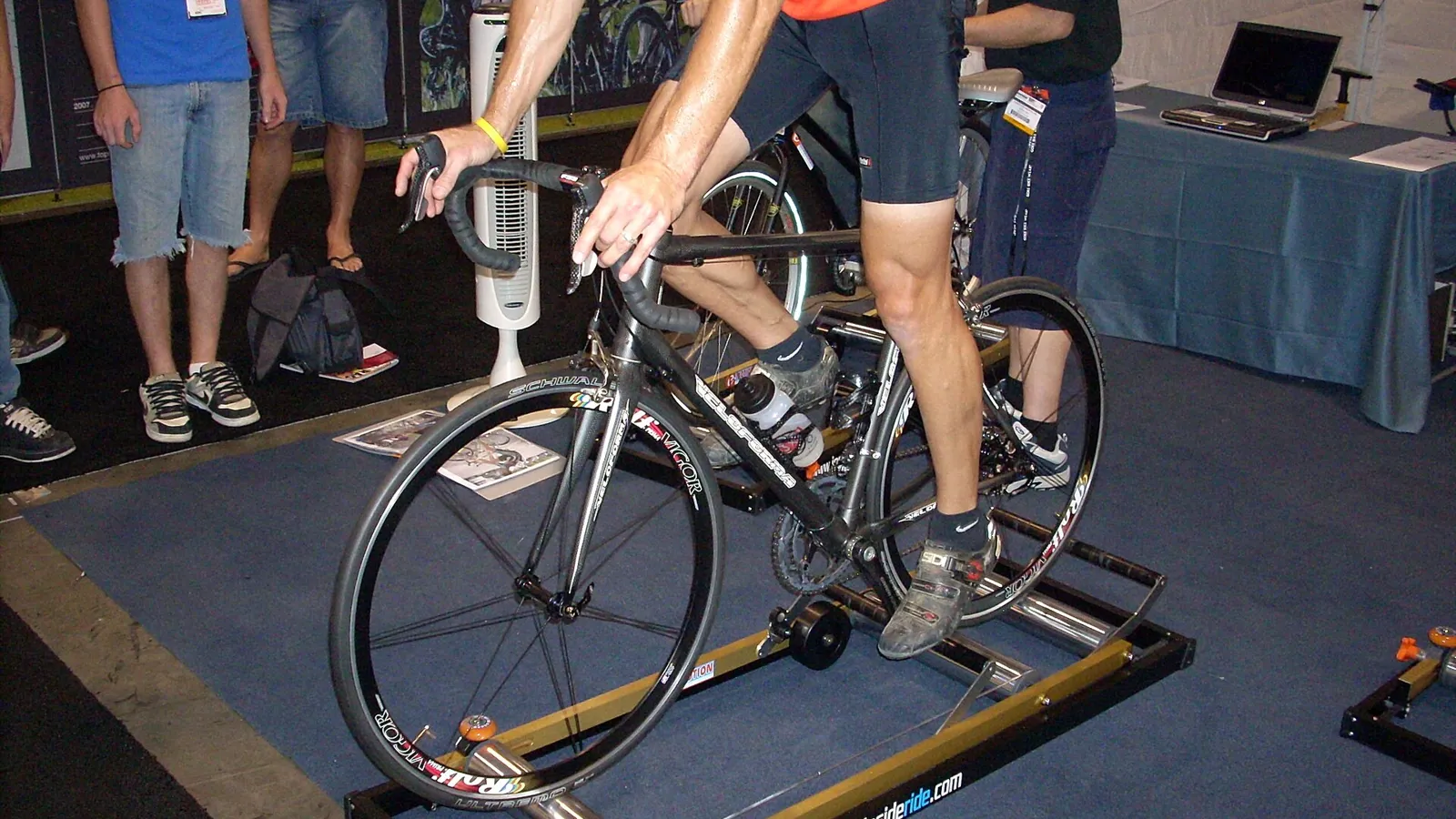
Turbo trainer workouts: where to start
When the evenings get dark and the rain arrives, the turbo trainer becomes the only way many riders keep their consistency. The trouble is that an hour spinning in the garage with no plan is dull, and it leads to two classic mistakes: riding everything hard or everything easy. The fix is a session for every evening, with one clear purpose and a length that fits your day.
Below you will find 6 ready-made workouts: two of 30 minutes, one of 45 and three of 60. Each one gives the effort in three ways: perceived effort from 1 to 10, a rough heart rate guide, and, if you have a power meter or smart trainer, a percentage of your functional threshold power (FTP). If you do not know what FTP is yet, read our beginner guide to cycling power first.
Which indoor trainer: rollers, wheel-on or smart trainer
Free rollers (three drums the wheels spin on) demand balance and are excellent for a smooth pedal stroke, but you cannot do hard efforts from a standstill and there is no adjustable resistance. Wheel-on trainers, with the rear wheel clamped against a roller, are the most common: stable, affordable, a bit noisy, and they wear the rear tyre. Smart trainers, wheel-on or direct drive, adjust resistance by themselves and talk to apps and watches. With direct drive you take off the rear wheel and mount the cassette on the trainer, which is quieter.
Every session below works on any type. Without a power meter, use perceived effort and a heart rate strap. For a deeper look at set-up and apps, read our article on indoor training with a smart trainer.
How to measure intensity: feel, heart rate and watts
The most common cycling zones come from FTP, roughly the power you could hold for an hour. Zone 2 (endurance): 56-75% of FTP. Zone 3 (tempo): 76-90%. Zone 4 (threshold): 91-105%. Zone 5 (VO2max): 106-120%. With no watts, go by effort: zone 2 is 4-5 out of 10 and you can speak in full sentences; tempo is 6-7 and you speak in short phrases; threshold is 7-8 with a few words only; VO2max is 9 and lasts a few minutes at most.
Heart rate percentages vary a lot from person to person because maximum heart rate does. If you want to use them, follow our guide to heart rate zones. Indoors your heart rate usually runs a little higher than outside for the same effort because of the heat, so perceived effort is often the better guide.
Workouts 1 and 2: the two 30-minute sessions
Workout 1, Quick base (30 minutes). 5 minutes of progressive warm-up, 20 minutes in zone 2 at 85-95 rpm, 5 minutes easy. This is for the evening when you are tired: low effort, high regularity, ideal for building base and for the days between two hard sessions.
Workout 2, Short sprints (30 minutes). 8 minutes of warm-up including 3 accelerations of 20 seconds, then 8 repeats of 30 seconds very hard (effort 8-9) with 90 seconds easy in between, which makes 16 minutes, and 6 minutes easy. Short sprints stress the cardiovascular system without long holds, and time flies. Do it once a week at most.
Workout 3: 45 minutes of tempo
10 minutes of warm-up, then 3 blocks of 8 minutes in zone 3, at 85-90% of FTP or effort 6-7, with 3 easy minutes between blocks, and 5 minutes to cool down. Tempo work pays off for anyone preparing for a granfondo or long spring rides: sustainable, yet hard enough to improve endurance.
If you cannot hold the pace in the last block, you started too hard. The aim is to finish the last block at the same intensity as the first, or slightly higher.
Workouts 4, 5 and 6: the three 60-minute sessions
Workout 4, Endurance with cadence (60 minutes). 10 minutes of warm-up, 40 minutes in zone 2 with one minute at 100 rpm every 10 minutes without letting the effort rise, 10 minutes cool-down. It improves pedalling smoothness and builds aerobic base without taking too much out of you. To understand gearing, see our guide to gears, shifting and cadence.
Workout 5, Threshold (60 minutes). 15 minutes of warm-up, two blocks of 15 minutes at 90-95% of FTP (effort 7-8) with 8 easy minutes between, 7 minutes cool-down. It is hard, but it lifts the level of anyone who has been riding for a few months. Once a week is enough.
Workout 6, VO2max (60 minutes, experienced riders). 15 minutes of warm-up with 3 accelerations, 6 repeats of 3 minutes at 110-120% of FTP (effort 9) with 3 minutes easy between, 12 minutes cool-down. Only with a solid base, and ideally after talking to a coach. Do not repeat it more often than every 7-10 days.
How to organise your week on the trainer
For beginners, 2 sessions a week are enough: workout 1 or 4 for base and workout 2 or 3 for quality. After 4-6 weeks you can go to 3, with only one really hard session (5 or 6) and the others easy. On the other days a walk or a short bodyweight strength session rounds out the week without tiring your legs.
If you are aiming at a race or a granfondo in spring, keep one longer outdoor ride at the weekend whenever the weather allows: the trainer is a great tool, but it will not teach you to handle the bike, eat in the saddle or deal with wind. You will find ideas for rides in our routes. For a more general plan, start with the guide for beginners on how much to ride.
Making the trainer bearable: fan, water and boredom
Heat is the real enemy indoors: with no wind, sweat does not evaporate, heart rate climbs and the quality of the session collapses. Put a strong fan on your chest and face, hang a towel on the bars and keep a bottle within reach. As a starting point drink about half a litre per hour, more if you sweat a lot; for 60-minute sessions water is enough, and beyond an hour add a carbohydrate drink.
Against boredom, apps that guide the workout with power targets, a video or a playlist built around the session all help. A simple trick is to mark the blocks in advance, so your head works in intervals and not in a whole hour. To get an idea of how much energy you use, the table on calories burned cycling gives the order of magnitude.
Common mistakes on the turbo trainer
The first is riding in the middle all the time, in the limbo between easy and hard, which trains neither base nor quality. The second is a gear that is too big at low cadence, which loads the knees: stay between 85 and 95 rpm, and go above 100 only for short agility work. The third is skipping the warm-up: the first minutes get your body up to temperature.
Other mistakes: sitting motionless for hours in the same position (stand on the pedals for 10-15 seconds now and then), badly inflating and wearing out the rear tyre (trainer-specific tyres exist), having no fan, having no plan. And if you feel strong chest pain, dizziness or a pain that gets worse, stop: talk to a doctor before riding again.
FAQ
How long should a good turbo trainer workout be?
30-60 minutes is enough to train well. There are no descents or traffic lights on a trainer, so almost every minute is real pedalling, and an hour indoors is a full session. Beyond 90 minutes, boredom and heat usually lower the quality.
How often can I train on a turbo trainer?
Between 2 and 4 sessions a week, with at most 1 or 2 of them hard. If you are starting from scratch, begin with 2 easy sessions and add a third after a month.
Do I lose weight on the turbo trainer?
Pedalling uses energy like any activity, but body weight depends on the balance between what you eat and what you spend over weeks, not on a single workout. Easy, regular zone 2 sessions are the most sustainable. For rough figures see our calories table.
Do I need a smart trainer?
No. With a basic trainer and perceived effort or a heart rate strap the sessions work. A smart trainer makes it easier to hold watts and connect apps, but it is not essential.
Can I use my road bike on the trainer?
Yes, that is the most common use. On wheel-on trainers a dedicated trainer tyre saves your road tyre. With direct drive models you remove the wheel and mount the cassette.
Is the trainer better than riding outside?
When weather and safety allow, outdoors is irreplaceable for handling, wind and climbs. The trainer wins when it is dark, wet or you are short of time: a 45-minute session at home beats no ride at all.
How do I know I am in zone 2?
If you can speak in full sentences and breathe easily, you are in zone 2. With a power meter, stay between 56 and 75% of FTP.
Keep exploring
Attrezzatura consigliata
Affiliate links: if you buy through these links Velunite receives a small commission, at no extra cost to you.