Valencia puts 1 million on 1:59:30. Will anyone take it?
On 6 December Valencia pays 1 million euros to whoever beats the marathon world record, now 1:59:30. What that pace means, in numbers you can feel in your legs.
Free, in 1 minute: save routes, download the GPX and join group rides.
Sign up freeWritten by the editorial team at Velunite
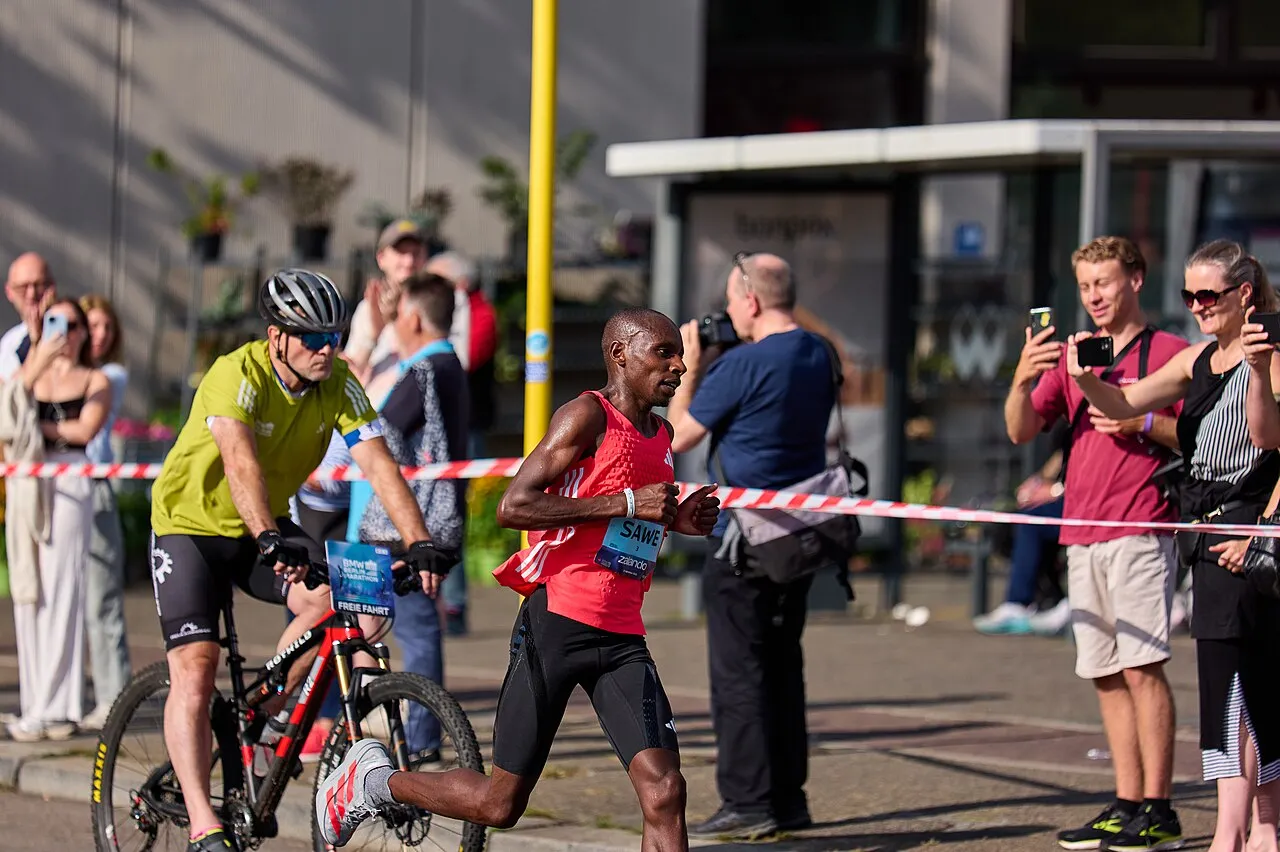
On 6 December, in Valencia, there is a million euros hanging over the finish line. It does not go to the winner: it goes to whoever runs a marathon faster than anyone before. And after London the time to beat has a name that looked like science fiction until April: 1:59:30. Here we try to turn it into numbers you can feel in your legs, and to ask whether a prize like this is good or bad for the marathon.
What is at stake (and what is not)
The bonus has existed since 2024 and, according to El Debate, Juan Roig, the businessman behind the Trinidad Alfonso Foundation that backs the race, confirmed it for 2026 on 7 December 2025: it applies to men and women, and Roig does not rule out raising it, but only after someone breaks the record. Correre.it and Marathon Handbook agree on the amount and the backer. The race is on Sunday 6 December 2026, a date given by correre.it and by a running news aggregator.
The delicate point is what counts as a record. For men it is simple: 1:59:30. For women correre.it notes that things are less clear: the overall record is Ruth Chepngetich's 2:09:56, Chicago 2024, in a mixed race; the women-only record is Tigst Assefa's 2:15:41, London, 26 April 2026. We have not read the official regulations, so we do not know how Valencia settles this, nor whether beating the record by one second is enough or something more is needed. If you find it, tell us.
London, 26 April: the time to beat
That day Sabastian Sawe won the London Marathon in 1:59:30, the first time under two hours in a race that can count as a record. The previous mark, Kelvin Kiptum's 2:00:35 from Chicago 2023, fell by 65 seconds. He was not alone: Yomif Kejelcha was second in 1:59:41 and Jacob Kiplimo third in 2:00:28, also under the old record. Marathon Handbook and the race's Wikipedia page report the same times. On official ratification we found no confirmation in the two sources we read, and we say so for honesty.
One detail we like: the group went through halfway in 1:00:29 and Sawe ran the second half in about 59:01, nearly a minute and a half faster than the first. If you read our piece on Chicago and Kipruto you know this lesson keeps coming back: big times are decided after the 30th kilometre, not before.
2:50 per kilometre, explained in track laps
Let's do the maths. 1:59:30 is 7,170 seconds. Divided by 42.195 km it gives about 170 seconds per kilometre, that is 2:50/km, or 21.2 km/h on average for almost two hours. In track laps: 68 seconds per 400 metres, for 105 and a half laps in a row. If you have ever run a 400 on the track, you know what it takes to do just one in 68.
One more comparison, our way. If you run a marathon at 5:00/km you finish in 3:31, a very respectable result. In the 170 seconds Sawe takes to run a kilometre, at 5:00/km you cover 566 metres: you give him 130 seconds every kilometre. And 21 an hour is, think about it, an average many of us hold on a bike on a flat stretch: he holds it running, on foot, for two hours.
Does a million change the race?
Here we are divided, and we tell you so. On one side a prize like this brings the world's best to Valencia and pushes them to take risks: starting at record pace is a gamble, and without an incentive many would prefer the safe win. On the other side there is the risk that the race becomes an event built around a number, with pacemakers, locked-in rhythms and less tactics, as in record attempts. The leading group in London, six men in line at the same pace, was a little like that.
We honestly like that a race exists that says openly what it wants: a time. We do not believe, though, that the million makes legs faster: the difference is made by a flat course, December weather and a lucky day. Who will show up? We found no confirmation that Sawe will be on the start line, and we do not want to take it for granted.
And for those of us who really run
You do not need 2:50/km to enjoy this story. Take your race pace and put Sawe's next to it: the marathon time calculator tells you where you would finish at your pace, and the pace calculator shows your splits. It is a concrete way to see how much road there is, or is missing, between a 3:30 and what we will see on 6 December.
Where do you stand: does a million-euro prize help the marathon, or turn it into an experiment? And if you had a single attempt, would you start at 2:50 per kilometre to see how long it holds? Tell us in the comments.
Comments (0)
No comments yet. Be the first!
Attrezzatura consigliata
Affiliate links: if you buy through these links Velunite receives a small commission, at no extra cost to you.
More articles
Latest from the Journal
- Hinault and LeMond, 1986: betrayal or a team lesson?October 21, 2026
- Amsterdam, 2:03:33 in the rain, and a faster second halfOctober 21, 2026
- New York 2026: 50 years of five boroughs and three ItaliansOctober 20, 2026
- Sallanches 2027: the Domancy, twenty times, and Pogačar's planOctober 20, 2026