Group Ride Etiquette: The Unwritten Rules of Riding Together
Pacelines, pulls, signals, stops and coffee: how to behave in a group so you get invited back and nobody crashes.
In 1 minute: save routes, download the GPX and join group rides.
Sign upWritten by the editorial team at Velunite
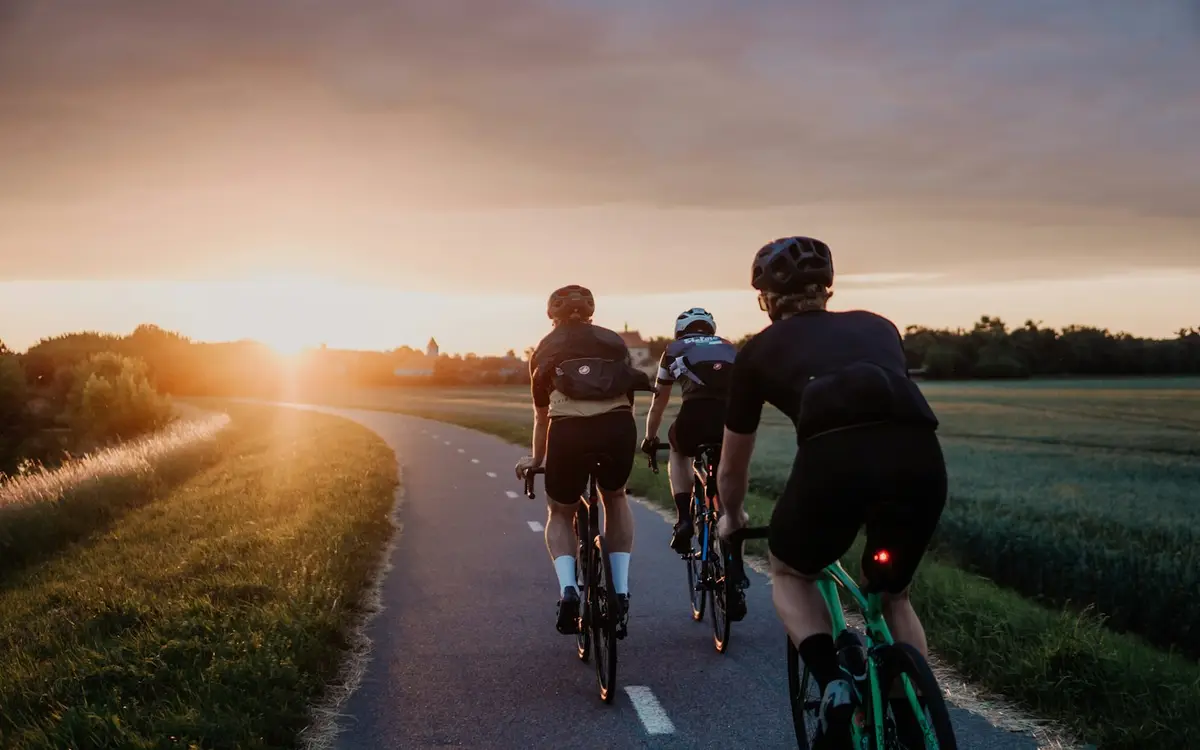
Riding in a group is one of the best things about cycling: you chat, you go faster with less effort thanks to the draft and the coffee halfway round tastes different. But the group has unwritten rules, and breaking them is the quickest way to stop being invited or, worse, to cause a crash. This guide gathers the etiquette experienced groups follow without saying it, with an eye on how to behave on your first group ride.
The wheel in front is sacred
Rule number one: never overlap your front wheel with the rear wheel of the rider ahead. If the rider in front swerves for a pothole and your wheel is touched, you are almost always the one who goes down. Stay slightly offset to the side or well back, and keep movements smooth and predictable: no sudden surges, no hard braking without reason, no fantasy lines. When you join a group ask how rotations work and keep the usual gap, which is typically one to two wheel lengths at normal speed.
Signalling is a duty, not a courtesy
Whoever is in front has the eyes of the whole group: potholes, gravel, cars and pinch points must be signalled by hand and by voice, and the signal is passed back to the last rider. One hand points to where the obstacle is, the other, raised, signals braking or stopping. Short clear words like hole, car back, narrow save wheels and bones. When you are on the front, speed changes should be gradual, without suddenly standing on the pedals, because the riders behind lose your wheel.
The pace belongs to the group, not to you
If the agreement is an easy ride, nobody attacks on a climb to prove something: anyone who wants to push the pace agrees it beforehand. The group adapts to the slowest rider, or splits at the start into two groups with different paces, without embarrassment. Someone with a puncture or mechanical problem is always waited for, and everyone restarts together after the stop. If you can't keep the pace of a ride, say so straight away: it is much more useful than disappearing on a climb.
Single file, space and the highway code
The Italian highway code normally requires single file and allows riding two abreast at most when conditions permit; single file is mandatory at night, in tunnels and where traffic requires it. Squeezing the group onto the verge isn't only dangerous but worsens relations with drivers. When a car comes, the group lines up and the leader calls it. On safety see also riding safely in traffic.
Drafting and rotations: how to pull
If you ride behind another wheel, the draft reduces effort but asks for attention: look a little further ahead than the rider in front, not just at their wheel. In a rotating group you take a turn on the front and then move to the side, letting the others through; anyone who doesn't want to pull says so without shame. It isn't compulsory, but it is correct to say. Avoid letting the others drift back at every change by keeping a constant speed.
What never to do
Don't use triathlon aero bars in a group, don't wear headphones at high volume, don't brake suddenly without warning, don't cut across a companion's line in a bend, don't leave litter on the road: gel wrappers and punctured tubes go home with you. And don't look at your phone while in line. Clothing and rear lights count for visibility too: if the group sets off in poor light, everyone has lights on.
At the stop and the coffee
The break is part of the ride: you wait for those who arrived late, fill the bottles and restart in order. The rule on who pays for coffee varies from group to group: among friends you alternate, or split. A thank you to whoever organised the route costs nothing and makes it easier to repeat the ride.
If you are organising the ride
State the average pace, climbing and meeting point, share the track a week ahead and update anyone who doesn't know the route. For all the details see the guide to organising a group ride, especially the part on pace and the single chat.
Frequently asked questions
Can I join a group without knowing anyone? Yes: choose rides declared as social, introduce yourself and ask about pace and distance.
What should I bring? A spare tube, pump or CO2, spare water and food, your phone and a little money.
What if I fall behind? A good group waits for you at summits or junctions; if that isn't possible, the leader tells you beforehand.
In short
Predictability, signalling and respect for the agreement on pace: with these three things you are welcome in any group, from the Saturday ride to the gran fondo. Cycling is an individual sport enjoyed in company, and company is earned with behaviour, not watts.
Recommended products
In a group, being seen is a duty: a compact flashing rear bike light signals your position to whoever sits on your wheel.
Shouting potholes is not always enough: a clear-sounding bike bell cuts through wind and traffic.
The group hero is whoever fixes things: a pocket bike multitool with chain breaker solves punctures and adjustments with no team car needed.
For shared refueling at stops, multipack cycling energy bars are always in the pocket of seasoned group riders.
As an Amazon Associate, Velunite earns from qualifying purchases. Some links in this article are affiliate links: if you buy through them Velunite may earn a small commission at no extra cost to you.
More articles
Latest from the Journal
- Milan circuit at the 2026 Giro: safe or not? Who is rightNovember 4, 2026
- Verona Run Marathon 15 Nov: entries, the Arena and the courseNovember 3, 2026
- 2027 Giro d'Italia route: stages, double Mortirolo and ZoncolanNovember 3, 2026
- 2027 Giro d'Italia stages: all 21 stages, km and official routeNovember 3, 2026