Dörfel runs a 2:20:46 marathon debut, and without a watch
Frankfurt 2026: Blanka Dörfel debuts in 2:20:46, second-fastest German ever, running without a watch. What to copy and what not to, with the pace maths.
Free, in 1 minute: save routes, download the GPX and join group rides.
Sign up freeWritten by the editorial team at Velunite
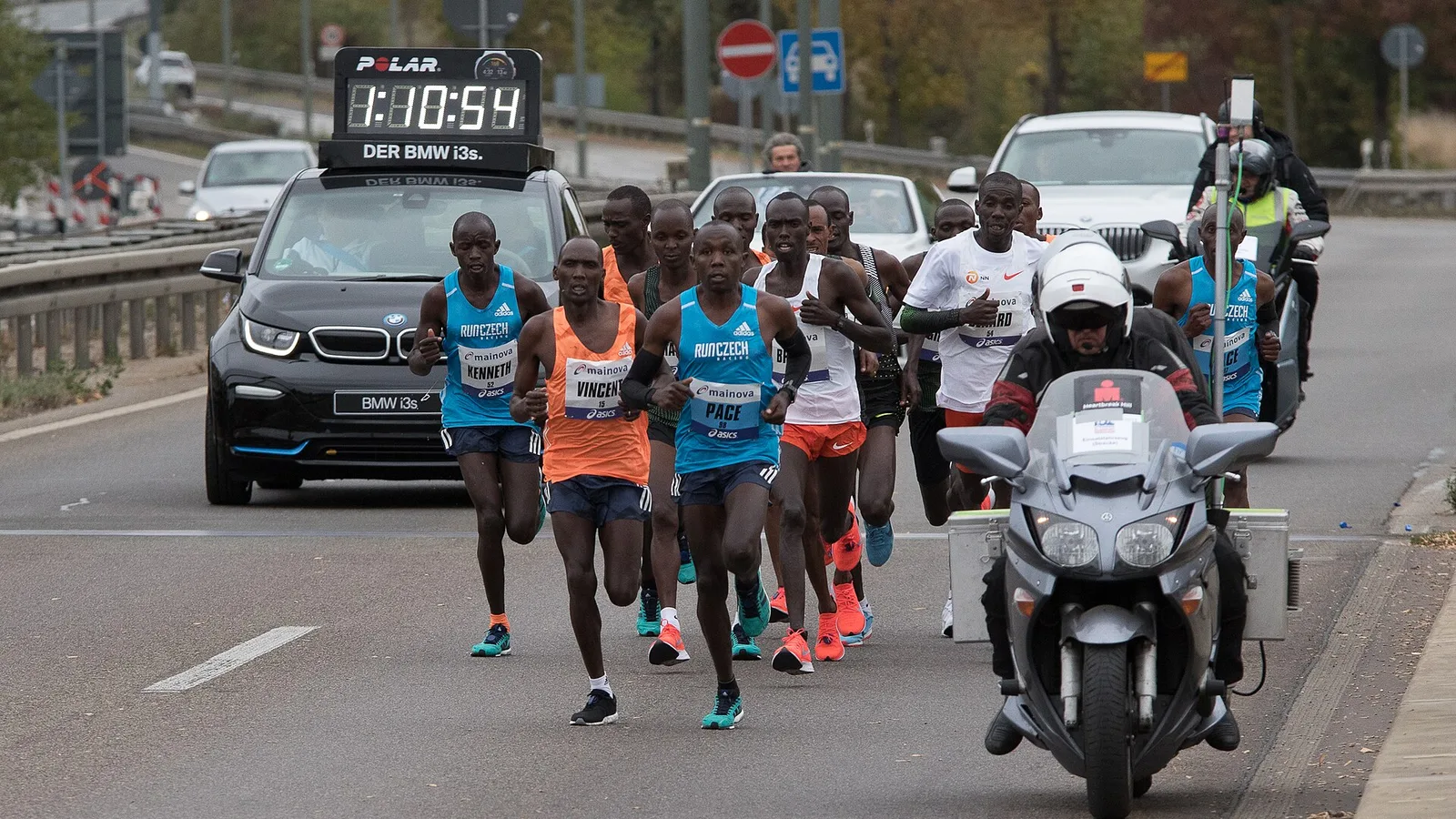
On Sunday 25 October, at the Mainova Frankfurt Marathon, a 24-year-old in her first 42 kilometres finished second in 2:20:46, and she ran it without a watch. Her name is Blanka Dörfel and she is now the second-fastest German woman ever over the distance. It is worth stopping on how she ran, because there is a question inside it that every runner asks sooner or later: does the watch help us or fool us?
What happened in Frankfurt
The 43rd edition had two Ethiopian winners: Jirata Dinki in 2:05:26 among the men and Zeineba Yimer in 2:19:45 among the women, as reported by the organisers and Runner's World Germany. Rain and wind spoiled the record plans: at 10 kilometres the split of 29:55 already pointed to a finish just over 2:06, and the leading group reached the half in 1:03:01.
Among the men, Germany's Amanal Petros, reigning European champion and national record holder with 2:04:03, was second in 2:05:46, ahead of Kenya's Benard Biwott, third in 2:06:23. Richard Ringer was fifth in 2:07:07 and Samuel Fitwi seventh in 2:08:57. The organisers write that he is the first German on the men's podium in over 25 years, Runner's World Germany writes "this millennium": the two wordings do not match and we prefer not to pick one.
Dörfel: 2:20:46 on debut
Blanka Dörfel, the German 10,000 metres champion, broke away from a chasing group of ten, went through the half in 1:10:29, and from the 27th kilometre her direct rivals could no longer follow. At the 33rd she moved into second place and stayed there. Third was Ethiopia's Beriha Gebreslasie in 2:22:46.
Her time is the second-fastest ever by a German woman, after the 2:19:19 with which Irina Mikitenko won in Berlin in 2008, and it is the best debut by a German woman over the distance (the previous one, 2:23:57, belongs to Melat Kejeta in Berlin 2019). According to the organisers it is also the eighth-fastest European time of all time. These facts come from two sources, the organisers' release and Runner's World Germany, and they agree.
The maths: a faster second half
Let us do our own sum, which does not come from the sources. 2:20:46 is 8,446 seconds over 42.195 kilometres: about 3:20 per kilometre. If she went through the half in 1:10:29, the second half took 1:10:17: twelve seconds faster than the first. On wet roads, with the last five kilometres that she herself called very hard, that looks remarkable to us.
One honest limit: we have only one intermediate split, not the five-kilometre splits, so we do not know whether the pace in between was really even. What we can say is that anyone who has run a marathon knows how rare it is to finish stronger than you started, even more so on debut.
The number to remember, the one that stayed with us: three minutes twenty per kilometre for forty-two kilometres, with the second half twelve seconds faster than the first.
Without a watch: is she right?
After the finish Dörfel said she runs without a watch even in training, going by feel, and that she only saw the 2:20 on the clock when she entered the Festhalle: until then, the time she could run was a question mark for her. It is fair to add, as regional broadcaster hessenschau recalls, that she is already German 10,000 metres champion: she is hardly a beginner at feeling her own pace.
We at Velunite do look at the watch, and we are not ashamed of it. But there is a difference between not having one and not needing one: she has years of racing in her legs, many of us do not. Our view, an opinion and not a rule: on debut the watch is mostly there to hold you back in the first kilometres, when everything feels easy. Then try, only in training, a long run with the display covered and a pace that feels sustainable: if you do not feel well, stop and leave it. To set expectations there is our marathon time predictor, which gives a starting number, not a certainty.
And with Sunday's rain? Anyone who runs a wet autumn race knows how the feet suffer: she said so herself, talking about foot baths. If the season catches you off guard, our guide to running clothing for autumn and winter is a good place to start.
Frankfurt turns a page
Sunday was also Jo Schindler's last race as race director after 25 years. The organisers write that the race has found a strategic partner in London Marathon Events and a successor in Holger Kranz. A record 19,720 runners from 128 nations entered the Frankfurt Marathon.
The next big marathon is New York on 1 November: we covered it in New York 2026 and the three Italians. On 6 December comes Valencia, with the million dollars for the 1:59:30.
And you? Do you run with a watch or by feel? Have you ever tried a long run with the display covered, and how did it go? Tell us in the comments: we are curious whether Dörfel is a case apart or whether we all have a bit of trust in our legs.
Comments (0)
No comments yet. Be the first!
Attrezzatura consigliata
Affiliate links: if you buy through these links Velunite receives a small commission, at no extra cost to you.
More articles
Latest from the Journal
- Longo Borghini in Piasco and cyclocross is back: the pro weekendOctober 26, 2026
- Ganna, Ciccone, Carapaz: why pro contracts now get brokenOctober 25, 2026
- Venice, 2:07:31: a course record and a dropped bottleOctober 25, 2026
- Hinault and LeMond, 1986: betrayal or a team lesson?October 21, 2026