Clocks back: sunset jumps to 5:23 pm. What about your run?
On Sunday 25 October sunset in Milan goes from 6:24 pm to 5:23 pm. How to rearrange your running week around darkness, daylight and group runs.
Free, in 1 minute: save routes, download the GPX and join group rides.
Sign up freeWritten by the editorial team at Velunite
On Saturday evening in Milan the sun sets at 6:24 pm. On Sunday 25 October, at 5:23 pm. That is 61 minutes less, all at once, not 60: the day shortens on its own too. The clocks go back at 3 a.m. between Saturday and Sunday, and for anyone who runs after work it is the time of year when running becomes something else. It is worth deciding now how to handle it, not on Monday at 6:30 pm with your shoes in your hand.
The numbers for your city
The numbers are ours: we calculated sunrise and sunset with two independent methods, an online service and the standard astronomical formula, and they agree within a minute. Always check your own town, because they shift by a few minutes from one city to another. In Milan sunset goes from 6:24 pm on Saturday to 5:23 pm on Sunday, in Rome from 6:16 to 5:15 pm, in Naples from 6:11 to 5:09 pm. Sunrise, on the contrary, moves earlier: on Sunday in Milan it is at 6:51 am, the day before it was at 7:50. And the light keeps falling: in mid-November the sun goes down in Milan around 4:55 pm, and on the shortest day of the year, 21 December, just after 4:40 pm.
Do the maths on your own day. If you leave work at 6 pm, until Saturday you still had more than twenty minutes of sun ahead of you. From Sunday you start in the dark. It is a tiny difference on the clock and an enormous one in your legs, because the same road as ever, at 6:15 pm on a Monday, is a different road.
What really changes
It is not a matter of courage, it is about visibility. A runner in dark clothes is hard to see for someone driving, and we are not saying this to be cautious: it is the reason why evening runs call for a headlamp, a vest or reflective elements. We covered it in our guide to running in the evening and at night, and if you ride too, the guide to bike lights makes the same point.
We have made ourselves a rule, which is not science but works: you do the easy run when there is light or where there is street lighting, and you move the quality work to roads you know by heart. Fast repeats in the dark, on a pavement you have never looked at properly, are the stupidest way to get hurt. An easy run with a headlamp on a lit cycle path is, for many people, one of the best things about winter.
Three moves for the first week
First: the Sunday long run. With sunrise at 6:51 am and sunset at 5:23 pm, Sunday in Milan has about ten and a half hours of full daylight. If you can, the long run is now a morning thing, say starting around 8, which leaves the afternoon free. Second: pick one day of the week when you run with company. On the group rides page you find who runs near you: in a group you are more visible, you chat, and the dark evening weighs less. Third: pack Monday's bag on Sunday evening, with a charged headlamp and a light-coloured jacket. It sounds trivial and it is the thing that gets skipped most often.
If you need a reference for setting your winter paces, try our pace calculator: it is a simple way to start from sensible numbers.
Venice on Sunday: the 25-hour day
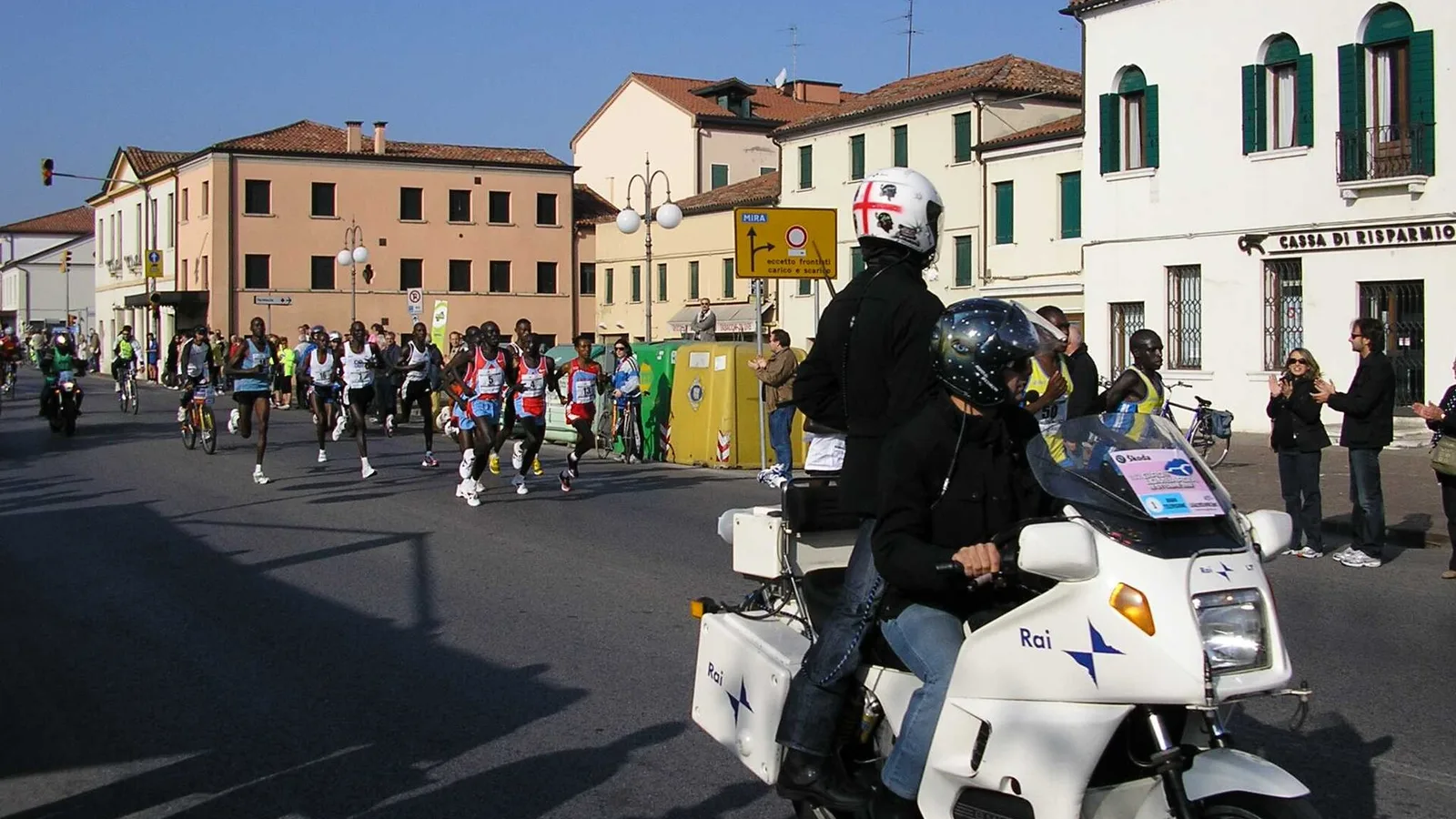
Sunday is not just the day the clocks change. In Venice the 40th Venicemarathon is run, sold out: about 23,000 entries across the marathon, half and 10 km, according to the organisers and the sports press. For the marathon the figure is 10,000 entries, and more than half of all entrants come from abroad. The start is in Stra, at Villa Pisani, around 9:40 am, so there is a bright morning ahead. Sunday lasts 25 hours, and the race clock does not notice: it measures the time you spend running, not the time on the wall. If you are on the start line, enjoy it, and if you are cheering from home, expect plenty of photos of bridges.
Permanent summer time: what do you say?
Every autumn people talk again about abolishing the double change, and every autumn the clocks change anyway. In 2026 permanent summer time was not approved: the sources we looked at describe stalled discussions, with no law. For anyone who runs after work the answer seems obvious, because with summer time all year the evening would be longer. But people who run at 6 a.m., and there are more of them than you think, see it the other way round: with permanent summer time, in the depth of winter, the sun rises around 8:30 or later.
Where do you stand: standard time and bright mornings, or summer time and long evenings? And when do you run, now that the dark arrives earlier? Tell us in the comments what your trick is for not giving up running in November.
Comments (0)
No comments yet. Be the first!
Attrezzatura consigliata
Affiliate links: if you buy through these links Velunite receives a small commission, at no extra cost to you.
More articles
Latest from the Journal
- Hinault and LeMond, 1986: betrayal or a team lesson?October 21, 2026
- Amsterdam, 2:03:33 in the rain, and a faster second halfOctober 21, 2026
- New York 2026: 50 years of five boroughs and three ItaliansOctober 20, 2026
- Sallanches 2027: the Domancy, twenty times, and Pogačar's planOctober 20, 2026